Kindergarten- What are we learning?
Week of Mar. 4 Level 1 Lesson 16 Week of Jan. 21- Week of Dec. 3- We read and discussed the story of Juan Diego, in the year 1531, when he saw La Señora de Guadalupe. She tells him to tell the bishop that they must build the church where she has appeared to him. It was a hard task to convince the bishop, but it is done through miraculous signs. This is a beloved Mexican story written in a children's book. |
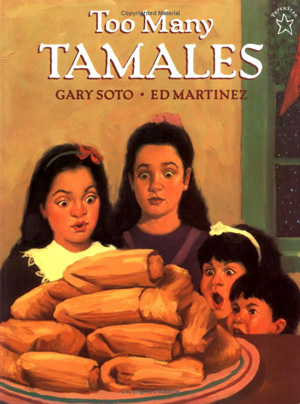 | Week of Nov. 26 We read a charming story by Gary Soto called "Too Many Tamales". We talked about the hispanic custom of making tamales for Christmas and other family customs. |
Week of Nov. 12
Week of Nov. 5
Level 1 Lesson 9
OBJECTIVES
Language
Recognize that the endings –ita and –ito indicate that someone or something is small and special
Associate new vocabulary with appropriate objects
Understand the commands Anda (Walk) and Salta (Jump)
Understand the declining value of numbers 10 to 1Culture
- Practice singing “The Finger Play Song”
Review
- Understand that Buenas tardes means Good afternoon
- Practice responses to the questions ¿Cómo se llama? and ¿Cómo te llamas tú?
- Respond to the commands Toca _____ (Touch ______) and Tráeme ______ (Bring me _______)
Vocabulary
¿Quién es? Who is it?
¿Qué es esto? What is it?
la bandera flag
el libro book
el lápiz pencil
el reloj clock
Anda. Walk.
Salta. Jump.Week of Oct. 22
Level 1 Lesson 8
OBJECTIVES
Language
- Match Spanish words for numbers 1 to 10 with Number Cards
Culture
- Sing along with, “Uno, dos, tres niñitos” (One, Two, Three Little Children)
- Recall that tú is used with children and usted with adults
Review
- Recall that the greeting Buenas tardes is used during the afternoon
- Recall the Spanish words for numbers 1 to 10
- Recall that Tráeme means Bring me, and Muéstrame means Show me.
Vocabulary
Vamos a contar Let’s count.
¿Cuántos son? How many are there?Week of Oct. 15
Students learn about the Day of the Dead and it's connection to the Catholic practices of All Souls and All Saints Days. Students color "calaveras" (colorful decorative skulls).
Week of Oct. 8
Level 1 Lesson 7
OBJECTIVES
Language
- Respond to the command Tráeme _____ (Bring me ______)
- Match the correct numerals to the words for numbers 1-10
Culture
- Recognize that tú is used with young peoplle and pets and that usted is used with adults
- Listen to the song “Uno, dos, tres niñitos” (“One, Two, Three Little Children”)
Review
- Name classroom ítems in Spanish: el escritorio (desk), la pizarra (chalkboard), el maestro (male teacher), la maestra (female teacher), el calendario (calendar)
- Recognize the numbers 1 to 5
Vocabulary
¿Qué número es? What number is it?
Tráeme ______. Bring me _____.
seis six
siete seven
ocho eight
nueve nine
diez tenWeek of Oct. 1
Level 1 Lesson 6
OBJECTIVES
Language
- Continue learning vocabulary for “El salón de clase” (The classroom)
- Count from 1 to 5
Culture
- Explore the usage of tú (familiar you ) and usted (formal you)
Review
- Recall that amiga refers to a female friend and that amigo refers to a male friend
- Sing the “Finger Play Song”
- Respond to the commands Muéstrame ______ (Show me ______) and Toca ____ (Touch ____)
- Practice naming classroom objects
Vocabulary
la pizarra chalkboard
la tiza chalk
uno one
dos two
tres three
cuatro four
cinco five
Hasta luego. See you later.
week of Sept. 24
Level 1 Lesson 5
OBJECTIVES
Language
• Match the correct picture to the words maestra (female teacher), maestro (male teacher), and calendario (calendar)
• Respond to the command Toca ____ (Touch ____)
Culture
• Sing the “Finger Play Song”
Review
• Sing “Buenos dias a ti” (“Good Morning to You”) and “Buenas tardes a ti” (“Good Afternoon to You”)
• Ask and respond to the questions ¿Cómo te llamas (tú)? (What is your name?) and ¿Cómo se llama? (What is his/her name?)
• Recall that la maestra refers to a female teacher and el maestro to a male teacher
• Review the meaning of Muéstrame ______ (Show me ______) using classroom objects
Vocabulary
José es el amigo. José is the (male) friend.
Rosita es la amiga. Rosita is the (female) friend.
el calendario calendar
Toca ____. Touch _____.
el escritorio desk
week of Sept. 17
Level 1 Lesson 4
OBJECTIVES
Language
- Notice that buenos and buenas, both meaning good, have different endings.
- Respond to the question ¿Quién es? (Who is it?)
Culture
- Observe that friends in Spanish-speaking countries usually greet each other by kissing each other on both cheeks
- Recognize that many people from other countries who live in the United States speak more than one language
Review
- Sing “Buenos dias a ti” (“Good Morning to You”) and “Buenas tardes a ti” (“Good Afternoon to You”)
- Correctly pronounce the rolled [r] sound
- Practice the opening conversation
- Ask and respond to the questions ¿Cómo te llamas (tú)? (What is your name?) and ¿Cómo se llama? (What is his/her name?)
Vocabulary
¿Quién es? Who is it?
Sí. Yes.
No. No.week of Sept. 10
L 1 L3
OBJECTIVES
Language 1.1, 1.2, 1.3
• Respond to the question ¿Cómo te llamas? (What is your name?)
• Respond to the question ¿Cómo se llama? (What is his/her name?)
Culture 1.1, 2.1
• Sing along with the song “Buenos días a ti” (“Good Morning to You”)
Review 1.1, 1.2, 1.3
• Review the greeting Hola (Hello)
• Practice the opening conversation
• Sing “Buenos días a ti” (“Good Morning to You”)
• Demonstrate the understanding of the command Muéstrame ______ (Show me ______)
Vocabulary
¡Olé! Hurray!
¿Cómo te llamas? What is your name?
Me llamo ____. My name is ____.
¿Cómo se llama? What is his/her name?
Se llama ____. His/Her name is ____.
Buenas tardes. Good afternoon.

